

Mental health challenges among adolescents and young adults continue to rise at an alarming rate. Rates of anxiety, depression, loneliness, self-harm, and suicidal ideation have increased across the United States and throughout much of the developed world. While clinicians, educators, and parents work tirelessly to support struggling youth, the question remains: Why are so many young people struggling in the first place?
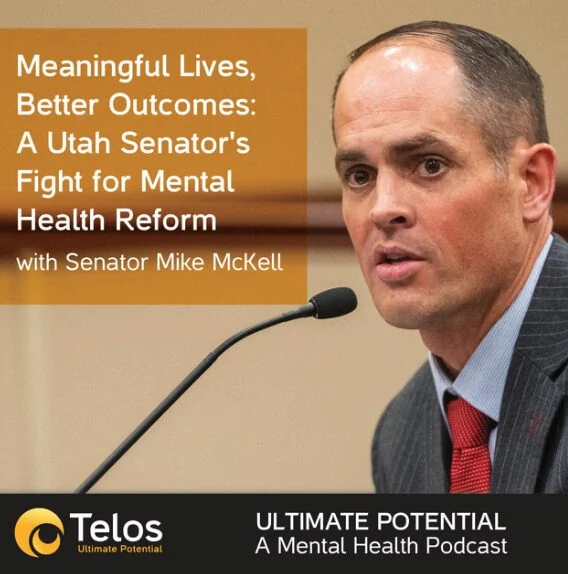
In a recent conversation on the Ultimate Potential podcast, Utah State Senator Mike McKell offered a unique perspective. Although he is best known as an attorney and legislator, McKell has become a prominent advocate for youth mental health, social media reform, and improvements in congregate care programs.
His observations highlight several forces shaping the mental health landscape today: technology, social disconnection, treatment quality, and perhaps most importantly, the human need for meaning and purpose.
A Growing Mental Health Crisis
Mental health challenges are no longer isolated concerns affecting only a small segment of the population. They have become a widespread societal issue.
According to Senator McKell, the problem extends far beyond Utah. The same troubling trends can be found across the United States, Canada, Australia, the United Kingdom, and much of Europe.
Despite increased awareness and expanded conversations about mental health, many indicators suggest that young people are struggling more than ever.
For families raising adolescents, this reality can feel overwhelming. Parents often wonder whether the world their children are growing up in is fundamentally different from the one they experienced themselves.
In many ways, it is.
The Hidden Cost of Constant Connectivity
One of McKell’s greatest concerns involves technology and social media.
Modern technology allows people to remain connected twenty-four hours a day. Information travels instantly. Communication is effortless. Social platforms provide endless opportunities for interaction.
Yet paradoxically, many people feel more isolated than ever.
As McKell observed, society is experiencing a strange contradiction: we are more connected digitally while becoming increasingly disconnected personally.
Community organizations that once served as gathering places are shrinking. Neighbors often know little about one another. Face-to-face interaction is increasingly replaced by screens, messages, and online engagement.
For young people, this shift can have profound consequences.
Adolescence is a developmental stage built around relationships, identity formation, belonging, and social learning. While technology can offer valuable tools, it cannot fully replace genuine human connection.
The result is a generation that may be communicating constantly while simultaneously feeling alone.
The Emerging Challenge of Artificial Relationships
While social media remains a significant concern, McKell believes the next challenge may already be emerging.
Artificial intelligence is transforming how people interact with technology. AI companions, conversational chatbots, and increasingly sophisticated digital relationships are becoming commonplace.
The technology itself is remarkable. The concern lies in how humans may choose to use it.
When authentic relationships are difficult, some individuals may gravitate toward artificial substitutes that feel easier, safer, or more predictable.
The danger is not technological advancement itself. The danger is the possibility that artificial connection begins replacing real connection.
Healthy mental health development depends on learning how to navigate real relationships—with all their imperfections, disagreements, disappointments, and rewards. No technology can fully replicate the growth that comes from genuine human connection.
For parents, this reality reinforces the importance of creating opportunities for meaningful family interaction, community involvement, and face-to-face relationships.
Why Community Still Matters
Throughout the discussion, McKell repeatedly returned to the importance of community.
Small-town fairs, service clubs, neighborhood organizations, faith communities, volunteer groups, and local activities may seem ordinary, but they provide something essential: belonging.
These institutions create opportunities for people to know one another, support one another, and feel connected to something larger than themselves.
As these structures weaken, many individuals lose an important source of identity and support.
This is particularly significant for teenagers.
Young people need places where they feel valued, seen, and connected. When those opportunities disappear, they often turn elsewhere in search of belonging. Sometimes that search leads to healthy communities. Other times it leads to unhealthy influences, destructive behaviors, or online spaces that intensify emotional struggles.
Mental health is not simply an individual issue. It is deeply connected to the strength of families, neighborhoods, schools, and communities.
Improving Youth Treatment Programs
The conversation also explored McKell’s work in improving oversight and accountability within youth treatment programs.
Like many industries, congregate care has experienced both success stories and failures. While many programs provide life-changing support to struggling youth, highly publicized incidents of mistreatment have generated understandable concern among families.
McKell became interested in treatment reform after learning about serious safety concerns involving a residential facility in rural Utah. As he began investigating the broader system, he discovered significant inconsistencies in resources, staffing, training, and oversight.
His goal was not to eliminate treatment programs. Rather, it was to ensure that vulnerable youth receive care from organizations that possess the appropriate resources, staffing, and expertise.
This led to efforts aimed at improving reporting standards, inspections, accountability, and treatment quality.
Why Matching Treatment to Need Matters
One of McKell’s strongest messages is that not every program can effectively serve every child.
Children arrive at treatment with vastly different needs. Some struggle with depression or anxiety. Others face trauma, substance abuse, behavioral challenges, autism spectrum disorders, or severe emotional dysregulation.
Effective treatment requires matching a child’s needs with a program that possesses the appropriate expertise and resources.
Problems arise when programs attempt to serve populations beyond their capabilities.
According to McKell, families should be cautious of any organization that claims it can successfully treat every type of challenge. Strong programs tend to have clear admissions criteria and a clear understanding of whom they can serve effectively.
Rather than trying to be everything to everyone, quality programs focus on providing excellent care to the populations they are specifically equipped to help.
What Parents Should Look for When Evaluating Programs
For parents considering out-of-home treatment, the process can feel intimidating.
McKell offered several practical suggestions.
Evaluate the Educational Program
One of the clearest indicators of overall program quality is the educational environment.
Programs that invest in qualified teachers, structured academics, and meaningful educational experiences often demonstrate a broader commitment to excellence.
By contrast, programs that rely primarily on worksheets, packets, or minimal educational engagement may signal deeper concerns about resources and priorities.
Visit in Person
Whenever possible, parents should visit a facility themselves.
Marketing materials can be impressive. Websites can be polished. Promotional videos can be persuasive.
Nothing replaces seeing the environment firsthand, meeting staff, observing interactions, and evaluating whether the program feels aligned with its stated mission.
Examine Staff Qualifications
The quality of any treatment program ultimately depends on the quality of its people.
Parents should ask questions about clinical credentials, staff training, teacher qualifications, and employee retention.
Strong facilities invest heavily in recruiting and retaining talented professionals who genuinely care about young people.
Talk to Other Families
Current and former families often provide the most accurate perspective.
Hearing directly from parents and former students can offer valuable insight into the culture, strengths, and limitations of a program.
Building Better Standards for the Future
One promising development discussed during the podcast is the creation of Utah’s Congregate Care Advisory Committee.
The committee was established to help define treatment standards and create meaningful distinctions between different levels of residential care.
The goal is straightforward: ensure that programs possess the resources, staffing, and safety measures necessary to serve the populations they admit.
By creating clearer standards and expectations, the committee hopes to improve outcomes for youth while reducing treatment failures and unnecessary risk.
These efforts represent an important step toward a more transparent and accountable treatment system.
The Missing Ingredient: Meaning
While technology, policy, and treatment reform are important, McKell ultimately believes that many mental health struggles stem from a deeper issue.
Too many people are living lives that feel disconnected from meaning.
In his view, a meaningful life involves contributing to something larger than oneself. It includes service, community involvement, responsibility, relationships, and purpose.
When people feel useful, connected, and needed, they often become more resilient.
When life becomes centered entirely on consumption, entertainment, comparison, or personal gratification, emotional well-being frequently suffers.
This is not merely a challenge for teenagers. It affects adults as well.
The search for meaning is universal.
A Message for Parents
Parents naturally want to protect their children from pain, disappointment, and hardship. Unfortunately, no parent can completely eliminate those experiences.
What parents can do is help their children build lives rooted in connection, service, purpose, and authentic relationships.
Encourage meaningful activities.
Prioritize family relationships.
Limit unhealthy digital influences.
Help children discover ways to contribute to others.
Model a life that is driven by values rather than convenience.
Mental health is influenced by many factors, some beyond our control. Yet fostering connection, belonging, and purpose remains one of the most powerful investments parents can make.
As Senator McKell suggested, the path forward may not be found solely in better technology, stronger regulations, or expanded services. It may also require helping young people rediscover something society has gradually lost:
A sense that their lives matter because they are connected to people, causes, and communities that matter.
And that kind of meaning is one of the strongest foundations for lasting mental health.

The Telos team includes licensed clinicians, therapists, educators, and family support specialists dedicated to helping teen boys and young adults find their way back. Our residential programs in Orem, Utah combine evidence-based clinical treatment with Cognia-accredited academics, structured community, and a relationship-first approach that produces real, lasting results. When families are searching for answers, we write to meet them where they are.
Not Sure Where to Start?
If you’re not sure which program is the right fit, our admissions team can help you better understand the differences between each option and what level of support may be the best fit for your son.
We’ll help you walk through the programs, answer questions clearly, and make sure you have a better sense of what comes next.